
 Bookmaker Reviews
 Casino
 Games
 Promotions
 Rewards
 Slots
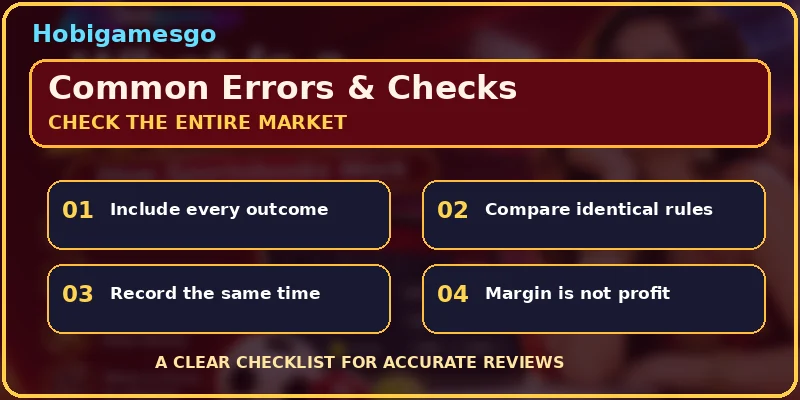
A football match offers three familiar outcomes: home win, draw and away win. Yet converting the bookmaker’s odds into percentages often produces a total above 100%. That difference is not a calculation error. It reveals an important feature of sportsbook pricing.
Bookmaker margin explained starts with this mathematical relationship. Bookmakers build a pricing allowance into their markets, commonly measured through overround. Understanding it helps readers distinguish estimated probabilities from the prices displayed by betting operators.
At Hobigamesgo, we examine how bookmaker margin works, why it differs across events and what the numbers reveal about sportsbook pricing. The following examples use hypothetical odds for educational purposes, not live betting recommendations.
Bookmaker Margin Explained – Meaning and Calculation
The margin is easiest to understand by comparing a theoretically fair market with one containing a pricing allowance. Both may describe the same sporting event, but their implied probabilities produce different totals.
What Is a Bookmaker Margin?
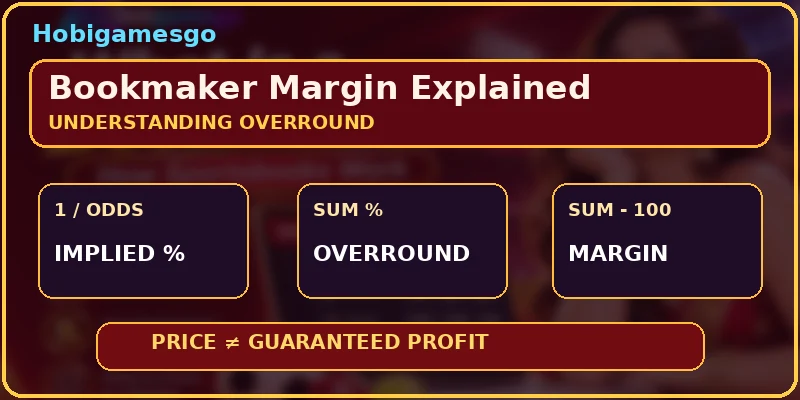
A bookmaker margin is the pricing allowance embedded in the odds offered across a betting market.
Imagine a hypothetical event with two equally likely outcomes. If each has a 50% probability, its fair decimal odds would be 2.00.
An operator might instead offer 1.90 on both outcomes. Each price corresponds to an implied probability of approximately 52.63%.
Together, those percentages total 105.26%.
The difference above 100% is the overround. In this example, it equals 5.26 percentage points.
This is the central concept behind bookmaker margin explained: the combined implied probability can exceed the mathematically complete probability distribution.
How to Calculate Overround Betting Margins
The first step in an overround betting calculation is converting every outcome’s decimal odds into implied probability.
The formula is:
Implied probability (%) = 100 ÷ Decimal odds
Next, add the implied probabilities for every mutually exclusive and collectively exhaustive outcome.
Finally, subtract 100 from the total.
Overround (%) = Sum of implied probabilities − 100
For a hypothetical three-outcome football market:
| Outcome | Decimal odds | Implied probability |
| Home win | 2.00 | 50.00% |
| Draw | 3.50 | 28.57% |
| Away win | 4.00 | 25.00% |
| Total | 103.57% |
The bookmaker margin measured as overround is approximately 3.57 percentage points.
This example describes the offered market as a whole rather than predicting any individual outcome.
Is Overround the Same as Profit Margin?
Not exactly.
A sportsbook’s realized profit depends on how much customers wager on each selection, which outcomes occur and how financial exposure is managed.
Overround measures the structure of quoted prices. It does not guarantee a particular profit on an event.
When bookmaker margin explained articles equate overround directly with the operator’s actual earnings, they overlook these important differences.
How Sportsbook Margins Affect Odds and Pricing
Sportsbooks do not use identical pricing models or commercial policies. Consequently, the margin embedded in one market can differ from another, even when both concern the same sporting event.
Why Do Bookmaker Margins Vary?
Several factors can affect sportsbook margin, including competition, available information, market liquidity and the operator’s assessment of risk.
Major football competitions may attract intense pricing competition. Smaller events may involve limited information or fewer market participants.
Margin levels can also vary by market type.
A match-result market and a specialist player-statistics market may carry different pricing allowances.
This explains why bookmaker margin explained cannot be reduced to a single percentage applicable to every sportsbook or event.
Comparing Two Hypothetical Sportsbook Margins
Consider two operators offering prices for a two-outcome event:
| Market | Outcome A | Outcome B | Overround |
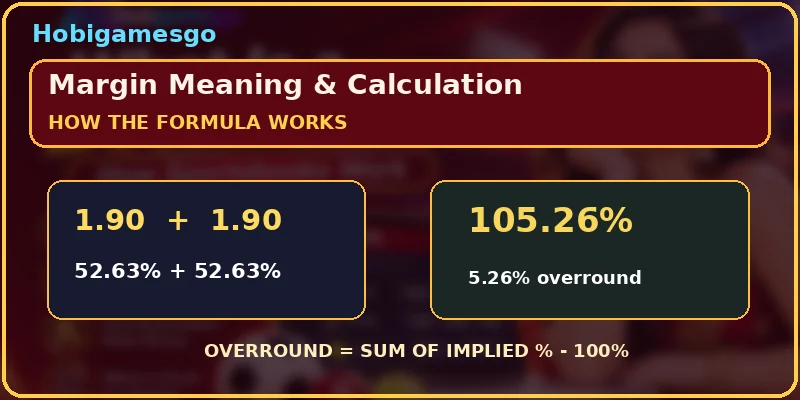
| Sportsbook A | 1.90 | 1.90 | 5.26% |
| Sportsbook B | 1.95 | 1.95 | 2.56% |
Sportsbook B has the lower calculated overround.
However, this observation alone does not establish that Sportsbook B is safer, better regulated or more suitable for any individual.
A proper bookmaker margin explained assessment separates mathematical pricing comparisons from operator reliability.
Other factors, including settlement rules and legal authorization, require their own evidence.
How Does Implied Probability Relate to Margin?
Implied probability is derived directly from the displayed odds.
However, when a market contains overround, the implied percentages cannot all be interpreted as unbiased event probabilities.
Analysts sometimes remove the overround to estimate normalized probabilities. A simple method divides each implied percentage by their combined total.
For instance, if two outcomes each carry odds of 1.90, their normalized probabilities become 50% each.
This proportional method is useful for illustration, but other margin-removal methods exist and can produce different estimates.
Understanding that limitation is part of a precise bookmaker margin explained analysis.
Bookmaker Margin Explained – Common Errors and Practical Checks
Margin calculations are straightforward once the market is defined correctly. Most misleading comparisons arise from incomplete outcome lists, mismatched rules or confusion between theoretical pricing and financial results.
Mistake 1: Calculating Only One Selection
The betting odds margin is a property of the complete market, not a single price in isolation.
For a standard three-way football market, the calculation requires home win, draw and away win.
Ignoring the draw produces an incomplete probability total.
Likewise, markets with several mutually exclusive outcomes require every relevant selection to calculate the full overround.
A reliable bookmaker margin explained guide should always identify which outcomes belong to the calculation.
Mistake 2: Comparing Different Market Rules
Two selections may appear similar but represent different events under the settlement rules.
For example, a football market covering regular time is not necessarily equivalent to one covering qualification after extra time.
The difference can affect both pricing and outcome definitions.
Before comparing sportsbook margins, readers must confirm that market scope and settlement rules match.
Otherwise, the resulting percentages can create a misleading comparison.
Mistake 3: Treating a Low Margin as a Guarantee
Lower overround means less pricing allowance in the displayed market under the specified calculation.
It does not eliminate uncertainty or guarantee a favorable financial outcome.
The same applies to claims that certain events offer consistently predictable returns.
A correct bookmaker margin explained assessment focuses on mathematics and transparency rather than promises about winning.
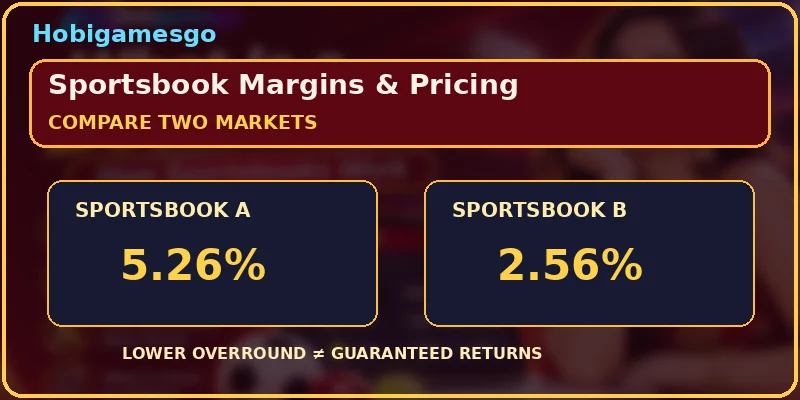
Checklist for Reviewing Bookmaker Margin
Use the following questions when studying sportsbook pricing:
- Are the displayed odds in the same format?
- Have all possible outcomes been included?
- Do the market definitions and settlement rules match?
- Were the odds recorded at comparable times?
- Is the calculation based on verified figures or illustrative examples?
- Is the overround clearly distinguished from realized operator profit?
These checks make bookmaker margin explained more useful for readers evaluating sportsbook information independently.
For Indian audiences, learning how odds are priced is separate from whether real-money betting is permitted under applicable law.
Frequently Asked Questions
What does bookmaker margin explained mean?
Bookmaker margin explained describes the pricing allowance incorporated into sportsbook odds, commonly measured by calculating overround.
What is overround in sports betting?
Overround is the amount by which the sum of implied probabilities across a complete market exceeds 100%.
Does a lower bookmaker margin guarantee profit?
No. It describes the pricing structure and does not determine the outcome of any particular sporting event.
Can bookmaker margins change over time?
Yes. A sportsbook can update its prices, causing the calculated overround to change as market conditions evolve.
Are bookmaker margin and house edge identical?
They are related concepts, but their calculations and applications can differ. Overround describes quoted market probabilities, while house edge is generally used for the mathematical advantage of a game or betting product.
Conclusion
Bookmaker margin explained reveals an essential difference between probability and sportsbook pricing. By converting decimal odds into percentages and calculating the overround, readers can understand how markets incorporate a commercial allowance.
That figure must still be interpreted carefully. Margin is not guaranteed operator profit, and lower overround does not remove financial risk.
Hobigamesgo encourages readers to use bookmaker margin calculations as a research tool, supported by accurate market definitions, transparent sources and realistic expectations.
