
 Bookmaker Reviews
 Casino
 Games
 Promotions
 Rewards
 Slots
A hand showing an ace and a seven can be worth either eight or eighteen. Add another card, and its value may change again. This flexibility makes Blackjack different from many traditional casino card games.
The objective is not simply to reach twenty-one. A player must finish with a stronger qualifying hand than the dealer or remain in the game when the dealer exceeds twenty-one.
Understanding Blackjack rules involves learning card values, recognizing available decisions and knowing when the dealer must draw another card. Small differences between table variations can also change the game’s mathematical characteristics.
At Hobigamesgo, this guide explains how to play Blackjack, read hand totals and understand the essential features of digital and live-dealer versions.
⭐ Blackjack Rules – Card Values and Winning Hands
The basic structure of Blackjack is easy to recognize: players receive cards, evaluate their totals and compare their completed hands with the dealer. However, several details determine how a round ends.
What Is Blackjack and What Is the Objective?
Blackjack, also known as twenty-one, is a comparing-card game played against a dealer.
At the beginning of a conventional round, the player receives two cards and the dealer receives two, with at least one dealer card visible.
The player’s objective is to beat the dealer without exceeding twenty-one. A higher qualifying total wins, while any hand above twenty-one immediately busts.
A dealer bust can also result in a win for players who have not already busted.
Unlike Poker, Blackjack does not require players to defeat other participants at the table.
Blackjack Card Values Explained
Understanding Blackjack card values is essential before examining strategy or special actions.
| Card | Point value |
| 2–9 | Face value |
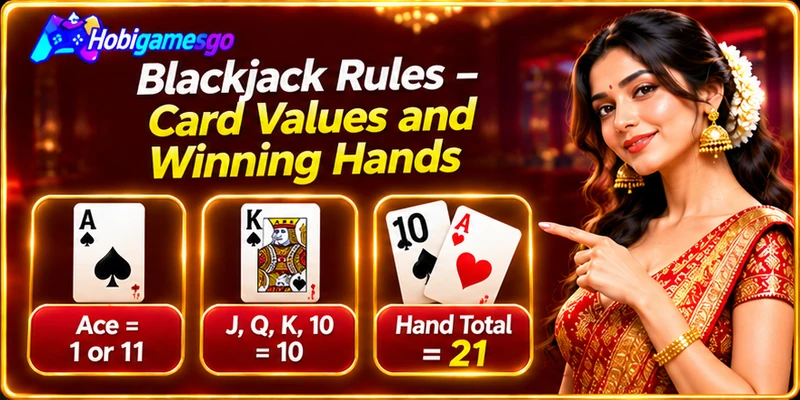
| 10, Jack, Queen, King | 10 |
| Ace | 1 or 11 |
For example, a nine and a queen total nineteen. A four, seven and king total twenty-one.
An ace and a six normally form a soft seventeen because the ace can count as eleven without the hand exceeding twenty-one.
If another card makes the higher total impossible, the ace may instead count as one.
This flexible scoring system is one of the defining features of Blackjack.
Natural Blackjack vs. an Ordinary 21
A natural Blackjack consists of an ace and a ten-value card dealt as the initial two cards.
It is distinguished from a twenty-one formed using three or more cards.
Under conventional rules, a natural outranks an ordinary twenty-one. If both player and dealer have naturals, the result is generally a push.
Payout rules vary between tables. A natural may pay 3:2 or 6:5, while certain variations use other terms.
These differences should be checked rather than assuming that every online Blackjack game follows identical conditions.
⭐ How to Play Blackjack – Decisions and Dealer Rules
The distinguishing feature of Blackjack is that players can make decisions after seeing their initial cards. These actions change the possible outcomes, although they cannot guarantee a favorable result.

Hit and Stand – The Two Basic Actions
To hit means requesting another card.
A player might choose this action when the existing hand is relatively low, but drawing another card always introduces uncertainty.
To stand means keeping the current total and ending further card requests.
For example, a player holding seventeen can stand rather than risk receiving a card that creates a bust.
Blackjack strategy examines these choices mathematically, but the appropriate decision depends on the player’s hand, the dealer’s visible card and the applicable rules.
Double Down and Split Explained
Double down allows a player, where permitted, to increase the original wager and receive exactly one additional card.
Split allows eligible pairs to become two separate hands. Each hand then follows its own drawing and settlement process.
For instance, two eights may be split into separate hands under standard table conditions.
However, splitting aces often has special restrictions, and a twenty-one formed after splitting usually does not count as a natural Blackjack.
Some versions also allow surrender, where a player gives up part of the original wager rather than completing the hand.
These options are important parts of Blackjack rules, but their availability differs between tables.
Blackjack Dealer Rules and Soft 17
Unlike players, the dealer generally follows mandatory drawing instructions.
In many conventional versions, the dealer must draw on totals of sixteen or less and stand on hard seventeen or higher.
A key variation concerns soft seventeen, such as an ace and a six.
Some tables require the dealer to stand on soft seventeen, while others require another card.
The distinction is commonly described as S17 versus H17.
These Blackjack dealer rules affect the mathematical structure of the game and should be clearly stated in any detailed game description.
A Practical Blackjack Round Example
Consider a player initially holding a ten and a six against a dealer showing a nine.
The player’s total is sixteen. The player must choose an available action under the table’s rules.
Suppose the player hits and receives a four. The total becomes twenty.
The player stands, and the dealer completes the required drawing procedure.
If the dealer finishes on eighteen, the player’s twenty wins. If the dealer reaches twenty-one, the player’s hand loses.
This example illustrates the sequence of how to play Blackjack, not a recommendation for handling every sixteen-point hand.
⭐ Online Blackjack – Probability, Strategy and Free Play
Digital interfaces can simplify card dealing and calculations, but they do not eliminate uncertainty. Understanding the technology and mathematical structure remains important.

Online Blackjack vs. Live Blackjack
Online Blackjack commonly appears as an RNG-based game or a live-dealer experience.
RNG versions use software to generate card distributions according to the game’s defined rules.
Live Blackjack generally involves physical cards, a real dealer and a video stream connecting the table to an online interface.
The presentation differs, but both formats still require understandable rules, transparent settlements and reliable information.
A realistic video does not independently establish that an operator is trustworthy.
Blackjack Strategy and the House Edge
Basic Blackjack strategy uses mathematical analysis to identify decisions associated with the lowest expected disadvantage under particular rules.
However, a strategy chart developed for one table variation may not apply perfectly to another.
The number of decks, dealer treatment of soft seventeen, double-down conditions and natural payouts can all influence expected returns.
Blackjack also contains random outcomes that players cannot control.
Even a mathematically appropriate decision can lose an individual hand.
The house edge therefore cannot be eliminated merely by following a pattern or expecting that recent losses will reverse.
Free Blackjack Games for Beginners
Some developers offer free Blackjack demonstrations using virtual credits.
These can help learners understand hit, stand, split, double down and the order of dealer actions without using real-money stakes.
A beginner can also practice recognizing soft hands and calculating totals.
However, demo sessions do not predict future outcomes in other versions of the game.
For readers in India, educational content and free gameplay must be distinguished from real-money gambling services and any applicable legal restrictions.
Hobigamesgo focuses on explaining Blackjack rules, probability and digital game mechanics with realistic expectations.
⭐ Frequently Asked Questions About Blackjack
What are the basic Blackjack rules?
Players aim to beat the dealer without exceeding twenty-one. Card values, player actions and the dealer’s drawing procedure determine the outcome.
How much is an ace worth in Blackjack?
An ace counts as one or eleven, depending on which value can be used without busting the hand.
Does a five-card twenty-one count as Blackjack?
No. A natural Blackjack specifically consists of an ace and a ten-value card in the first two cards.
Must the Blackjack dealer stand on seventeen?
Dealers generally stand on hard seventeen, but rules for soft seventeen differ between game variations.
Can Blackjack strategy guarantee a win?
No. Strategy can influence the mathematical expectation of decisions but cannot guarantee any individual result.
⭐ Conclusion
Blackjack combines straightforward card values with decisions that influence how a hand develops. Understanding naturals, soft hands, dealer rules and optional actions makes the game easier to follow.
Differences between table variations also explain why the same decision may have different mathematical implications under different conditions.
Through Hobigamesgo, readers can explore Blackjack rules using clear examples, free-play concepts and realistic expectations rather than misleading promises of guaranteed outcomes.
