
 Bookmaker Reviews
 Casino
 Games
 Promotions
 Rewards
 Slots

A hand containing a king and a seven has a value of seven. Add a six to a nine, and the result becomes five rather than fifteen. These unusual calculations are among the first things newcomers encounter when learning Baccarat.
Despite its elegant casino presentation, the underlying game is relatively straightforward. Two hands, known as Player and Banker, are compared according to a fixed scoring system. The objective is to identify which finishes closest to nine.
Understanding Baccarat rules requires more than recognizing card combinations. The automatic drawing procedures, natural hands and differences between betting outcomes all shape how each round is resolved.
This Hobigamesgo guide explains Baccarat card values, scoring examples and the mechanics behind common online and live-dealer formats.
⭐ Baccarat Rules – Understanding Cards and Scoring
The foundation of Baccarat is its point system. Unlike Blackjack, where players aim for twenty-one, the highest possible final value of a Baccarat hand is nine.
What Is Baccarat and How Does a Round Work?
Baccarat is a comparing-card game involving two designated hands: Player and Banker.
Both hands normally receive two cards at the beginning of a round. Their totals are calculated, and the game’s drawing rules determine whether additional cards are required.
The hand finishing closest to nine wins. Equal final values produce a Tie.
Importantly, Player and Banker identify the hands being compared, not necessarily the people sitting at the table.
In the widely played Punto Banco version, drawing decisions are governed by established rules rather than freely chosen by participants.
Baccarat Card Values Explained
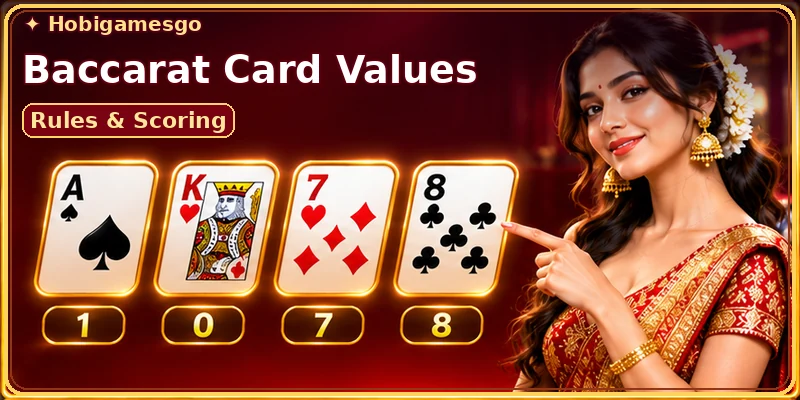
Understanding Baccarat scoring begins with assigning values to individual cards.
| Card | Baccarat value |
| Ace | 1 |
| 2–9 | Face value |
| 10, Jack, Queen, King | 0 |
Only the final digit of a hand’s total is counted.
For example, a seven and an eight produce fifteen, giving the hand a value of five. A nine and a six also produce a final value of five.
A king and a four produce four because the king contributes zero.
These examples illustrate why Baccarat card values differ from those of many familiar card games.
What Is a Natural Hand?
A natural occurs when the initial two-card total is eight or nine.
Under standard Punto Banco Baccarat rules, an initial natural ends the drawing process for both hands.
For instance, a Player hand containing a six and a three has a natural nine.
If the Banker hand totals seven, Player wins without any additional cards.
A natural eight can still lose to a natural nine, so the word natural does not mean an automatic victory.
Understanding naturals is essential for following the sequence of a round accurately.
⭐ How to Play Baccarat – Player, Banker and Third Cards
After the initial deal, the game follows a predetermined series of checks. Although the procedure may appear complicated at first, most of the work is handled automatically by the dealer or software.
Step 1: Understand Banker vs Player
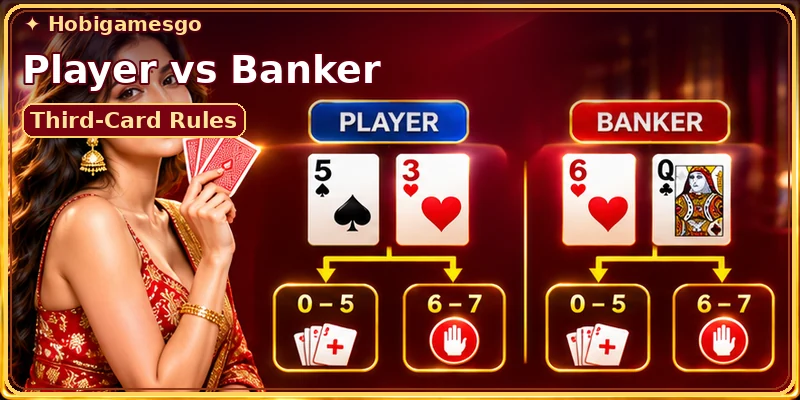
The principal outcomes in standard Baccarat are Player, Banker and Tie.
Player wins when its completed hand has a higher point value. Banker wins when the completed Banker hand is higher. Equal totals result in a Tie.
The terms do not indicate which hand is more deserving of a win.
For example, if Player finishes on seven and Banker on five, Player wins. If both finish on six, the result is a Tie.
Understanding banker vs player is therefore a matter of comparing the final scores, not interpreting the names literally.
Step 2: Apply the Player Third-Card Rule
The Player hand follows a simple procedure unless a natural has already occurred.
When its initial total is zero through five, Player draws a third card. On six or seven, Player stands.
An initial total of eight or nine is a natural and ends further drawing.
This makes the Player’s part of the Baccarat third card rules relatively easy to understand.
The Banker procedure is more detailed because it can depend on the value of the Player’s third card.
Step 3: Understand the Banker Drawing Rules
If Player stands on six or seven, Banker draws on totals of zero through five and stands on six or seven.
If Player draws a third card, Banker’s action follows a specific table:
| Banker’s initial total | Draws when Player’s third card is |
| 0–2 | Any value |
| 3 | Any value except 8 |
| 4 | 2–7 |
| 5 | 4–7 |
| 6 | 6–7 |
| 7 | Never |
Naturals take precedence over these conditions.
The dealer applies the Baccarat rules automatically; players do not choose when either hand receives another card.
This procedure is what makes third-card outcomes more intricate than the basic point system.
Step 4: Compare the Final Scores
After all required cards have been dealt, the completed totals are compared.
Suppose Player finishes with eight and Banker finishes with six. Player wins.
If both hands finish with four, the round ends in a Tie.
The winner is determined by the final point values, not by the number of cards received or the presence of picture cards.
A correct understanding of how to play Baccarat begins with recognizing this distinction.
⭐ Online Baccarat – Variations, Probability and Common Myths
Traditional card mechanics also appear in digital games. However, presentation, additional features and settlement conditions can vary between versions.

Live Baccarat vs RNG Baccarat
Online Baccarat commonly appears in two formats.
Live-dealer games use streamed physical cards and a real presenter. RNG versions use software to generate card outcomes according to their programmed rules.
A live presentation may resemble a physical casino table, while digital versions emphasize automated controls.
Neither format should be assumed more reliable solely because of its appearance.
Readers should examine the published rules, software information and relevant operator transparency.
Baccarat Odds and the House Edge
In standard eight-deck Punto Banco with conventional commission rules, the Banker outcome occurs slightly more often than Player.
This difference explains why conventional Banker wagers often involve a commission.
Typical theoretical house-edge estimates are approximately 1.06% for Banker, 1.24% for Player and 14.36% for Tie at an 8-to-1 Tie payout.
These figures depend on the specific version and rules. They do not predict an individual round.
The mathematical advantage built into Baccarat also means that no selection offers guaranteed profit.
Why Baccarat Patterns Cannot Predict Results
Scoreboards showing previous Banker, Player and Tie results are familiar features of live and digital Baccarat interfaces.
They record historical outcomes, but they do not provide a reliable formula for predicting the next hand.
A run of Banker wins does not mean Player must win next.
Although cards dealt from a physical shoe change its remaining composition, simple streak-following strategies do not overcome the game’s mathematical structure.
Interpreting historical results as guaranteed signals is a common mistake.
Free Baccarat Games and Responsible Play
Some developers provide virtual-credit or demonstration versions that allow readers to explore the scoring system without real-money stakes.
These can help explain natural hands, drawing procedures and table layouts.
However, a demo’s results should never be treated as evidence of future financial outcomes.
For readers in India, it is also important to distinguish educational card-game content from the legal status of online money gaming.
Hobigamesgo presents Baccarat as a subject for understanding game mechanics, mathematics and digital entertainment rather than as a source of guaranteed earnings.
⭐ Frequently Asked Questions About Baccarat
Is Baccarat difficult to learn?
The basic objective is simple: compare Player and Banker totals and identify the hand closest to nine. The third-card rules require more explanation but are applied automatically.
What is the value of a king in Baccarat?
Kings, queens, jacks and tens all count as zero. Aces count as one.
What happens when both hands have the same score?
The result is a Tie. Any related settlement depends on the applicable game rules.
Does Banker always win more often?
Under standard Punto Banco rules, Banker has a slightly higher unconditional winning probability than Player, but that does not guarantee victory in any particular round.
Can previous Baccarat results predict the next hand?
Historical streaks do not provide a reliable prediction of the next outcome.
⭐ Conclusion
Baccarat combines simple point totals with a precisely defined drawing procedure. Understanding the relationship between Player and Banker, the final-digit scoring method and natural hands makes the game easier to follow.
The third-card table explains why a completed round may involve different numbers of cards, while probability and house-edge concepts provide essential mathematical context.
Through Hobigamesgo, readers can explore Baccarat rules with clear examples, realistic expectations and a better understanding of how the game works.
